Thad contacts Stark through automatic writing
The Dark HalfThad contacts Stark through automatic writing in a scene where an experiment in communication becomes an involuntary encounter with both a living flock and another mind. The sparrows’ arrival confirms that Thad’s visions are not merely private, while his hand’s unbidden account of Miriam Cowley’s murder gives him direct access to Stark’s knowledge. Their connection is reciprocal and perilous: each can reach into the other’s experience, and each ultimately turns that contact against the other.
The attempt to make contact
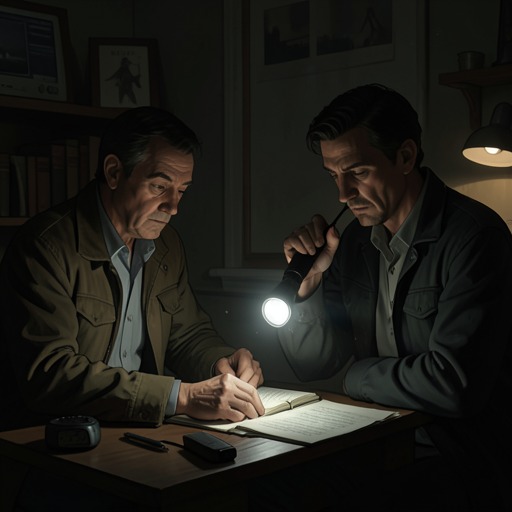
Thad turns to a fresh page in his journal, sets aside his pen, and takes a Berol pencil. Fear has already made the act feel consequential, but he proceeds, printing a declaration at the top of the page: The sparrows are flying again. The phrase joins the birds’ return to the reason for his experiment: he believes the birds are flying again because he and Stark are twins. Writing begins as a deliberate effort to test that connection, not as a normal act of composition.
At the window, a sparrow appears and is joined by others. The birds multiply along the carriage house, gathering on its weathervane until their weight makes it swing. Thad recognizes that they are real, and his study gives way to a vision of the Ridgeway section of Bergenfield, where he grew up. The silent neighborhood is covered with sparrows: they line roofs and telephone wires, fill trees, and gather on cars and familiar places from his childhood. In the vision, the birds seem to wait for a command. Their overwhelming presence turns the experiment from an attempt to reach Stark into an encounter with a force Thad had not understood.
Writing from the other mind
Thad’s body falls into a trance as the pencil begins moving across the journal. The writing bears his hand, but he experiences neither its words as his own nor normal sensation in his right hand. The pencil reproduces the indented paragraph opening characteristic of Stark’s writing, then begins a narrative about Miriam Cowley’s murder. What Thad receives is not a broken impression but a coherent account, recognizably produced by a writer whose fiction has reached millions of readers.
The discovery changes the meaning of the contact. Thad has succeeded in reaching Stark, but the connection is not a controlled exchange: he has tapped into Stark’s mind, just as Stark has apparently reached into his. The writing exposes Stark’s knowledge of the murder and demonstrates that the act of writing can transmit material between them. The pencil and journal are no longer simply Thad’s tools; they become the surface on which Stark’s thoughts appear.
A reciprocal struggle
Later, Thad asks through the writing why Stark wants to return to writing and whether the desire is important enough to kill people. The pencil hesitates and jerks before it responds, making the exchange seem strained rather than fluent. The contact breaks into action when Stark takes control of Thad’s arm and drives the pencil into the web of his left hand. The pain ends Stark’s immediate hold, but the incident makes clear that the mental connection can become physical danger.
The struggle also runs in the opposite direction. Stark writes a furious rejection of the sparrows and of Thad’s intrusion, then drives a pen into his own right hand. At that instant, Stark feels Thad making the corresponding movement with the Berol pencil in Maine. The two actions mirror one another across distance: each man’s attempt to hurt himself is linked to the other’s, and the shared pain breaks the immediate trance without simply erasing the awareness between them.
The sparrows and the limits of control
The birds’ later appearances make the scene’s recognition of their reality consequential beyond Thad’s study. At Gold’s Junkyard and Auto Supply, sparrows cover the stacked cars and trucks without making a sound; Rawlie DeLesseps identifies them as psychopomps and asks Thad what their presence means. Near the Williamses’ driveway, one bird lands on Alan Pangborn’s shoulder, moves onto his hand, then hops away. The flock’s proximity to Alan and its refusal to behave as a simple human-directed force underscore its independence.
On the road toward the lake house, Thad encounters a sharp boundary where the flock begins and realizes the birds have become the road itself: reaching the house will require driving over them. In the final confrontation, their role becomes explicit. Thad understands that the psychopomps have come to escort Stark back to the land of the dead, and they gather on Stark and overwhelm him. The automatic-writing episode thus foreshadows the birds’ decisive intervention while establishing a limit to human control: Thad can make contact with Stark, and the flock can answer the unfolding conflict, but neither can be reduced to a safe instrument of the other’s will.